About PayFURL
PayFURL is an Australian payment orchestration platform. It sits above the payments ecosystem, connecting merchants to a large network of gateways and processors through one API and dashboard, with smart routing, automatic failover and cost transparency, all under PCI DSS compliance. By the time we joined, the platform was well past MVP: a mature, six-year-old codebase running live in production. The company itself is lean, with founders based in several countries.


Overview
When PayFURL went through a change in technical leadership within its founding team, we were brought in as an engineering partner.
Agentic AI tooling, specifically Claude Code, allowed us to take ownership in weeks instead of months: operational on the codebase within 30 days, owning sophisticated delivery within the first quarter, compliance and live transaction flows intact throughout. Our first production deployment went live 12 days after we started.
With the platform in safe hands, the engagement expanded beyond engineering. We set up Claude Cowork and Claude Code as an operating layer for PayFURL's distributed founders, so a small team could run research, experiments and internal knowledge sharing at a scale its headcount would normally not allow.
The Challenge
A change in technical leadership meant PayFURL needed both continuity and momentum. We faced the following key constraints at the start:
- An inherited, mature codebase. Six years of accumulated logic, integrations, and design decisions, with limited access to the original architectural context.
- A live, regulated environment. Payments infrastructure does not tolerate learning in production. Stability and PCI DSS compliance had to hold from day one.
- Need for speed. The roadmap could not pause while a new partner slowly absorbed the system. We needed to be productive in weeks, not quarters.
- Managing growing responsibilities. We began with stabilising and maintaining the platform and quickly extended to partially refactor, improve, and prepare it for future growth.
- A lean, distributed company. PayFURL's founders work across the globe with little in-person contact. The company had no dedicated people for marketing, growth, lead generation, competitive research or operations, and knowledge was hard to share across the leadership team.

Scope of Work
The engagement moved through three stages: understanding the platform, making it safe to change, and then changing it. Once the platform was stable, we brought Claude into the way the whole company works.
AI-assisted codebase audit
A full audit of the existing codebase using Claude Code, mapping the system considerably faster than manual code archaeology allows, and reaching working command of the platform in 30 days.
Rebuilding system explainability
PayFURL's documentation was extensive but had drifted from the code. We reconciled the two and produced updated documentation plus executive dashboards, giving technical and non-technical stakeholders the same picture of what the platform actually does.
Mapping interdependencies
We traced and documented dependencies across modules, services, and integrations — turning a hard-to-understand system into a known one, so changes could be made without unintended downstream effects.
Raising daily observability
Every change needed traceability and an audit trail. We added layers of automated tests and improved daily monitoring, specifically to catch regressions, business logic leaking across modules, and unintended changes to existing architecture. Most of these tests were written with Claude Code. Between January and September 2026, the unit test suite more than doubled, from around 1,200 to over 2,500 tests, and API tests grew by nearly 30%, from around 400 to over 500.
Stabilisation and PCI DSS-compliant maintenance
We took over day-to-day maintenance and carried out the work required for the platform to remain PCI DSS compliant — protecting its core obligation to merchants throughout the transition.
Refactoring and new features
With the system understood, selected areas were refactored for maintainability and scale, and new client-facing features shipped during what would otherwise have been a holding period.
Claude as an operating layer for the company
We built asynchronous, multi-agent workflows in Claude Cowork that gather market and competitive intelligence, support lead generation, prepare internal documents and keep the founders working from the same information. Claude Code handles the harder implementation tasks that come out of this work. The team uses individual Claude Max plans, primarily with Claude Opus models.

Solution
From inherited code to production in 12 days
The usual way an agency inherits a legacy system is slow and quietly risky. New engineers spend months absorbing knowledge that was never written down, and every early change is a bet against undocumented behaviour. That was not an option here.
We took a different route. Using Claude Code for code intelligence, our team rapidly mapped the platform's structure, surfaced its interdependencies, and reconstructed the reasoning behind it.
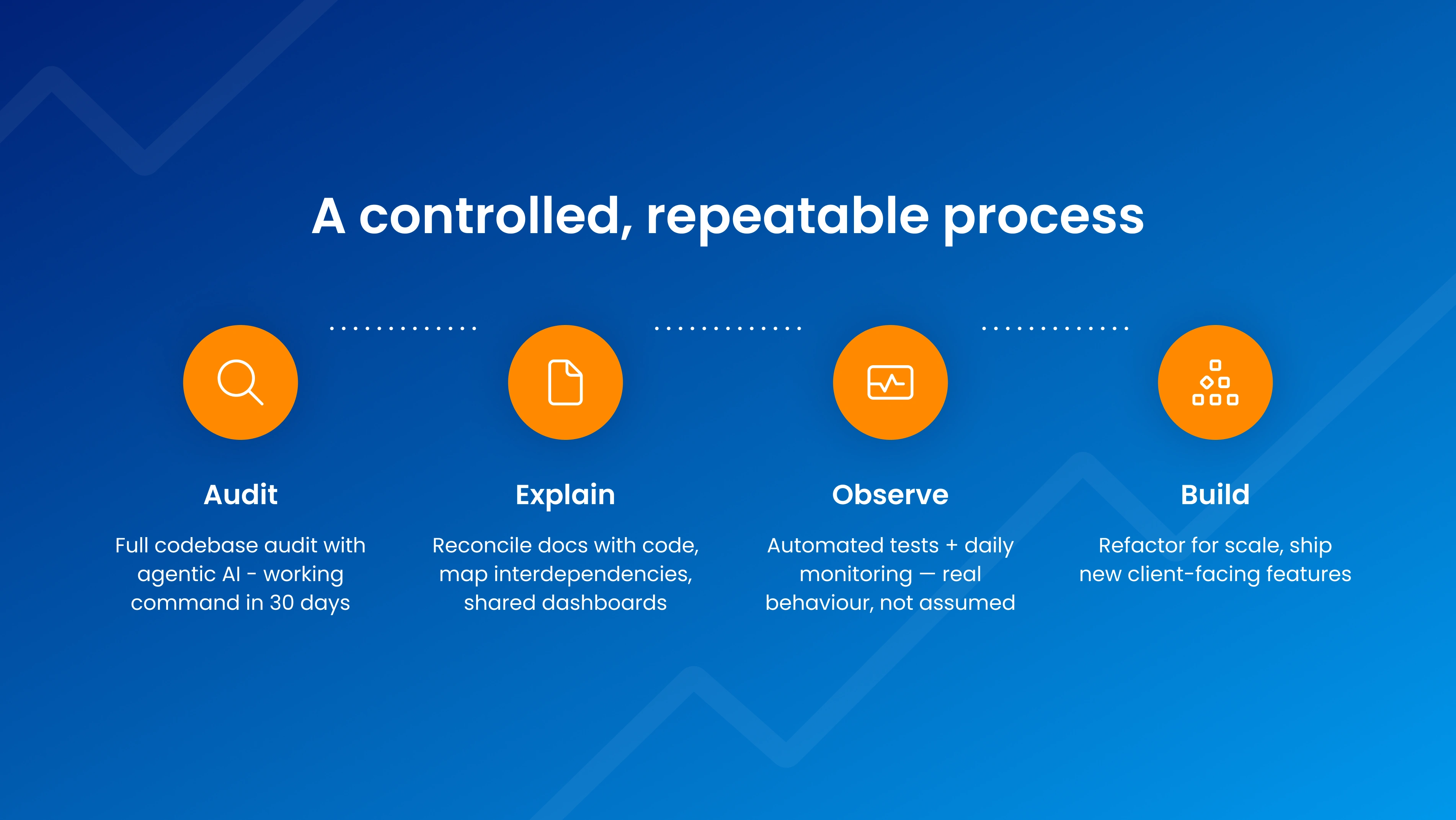
Engineers could change a six-year-old payments platform they had not written, and do it safely. What is usually a liability — taking over someone else's complex codebase mid-transition — became a controlled, repeatable process: audit, explain, observe, then build.
2-3x more experiments with the same team
We brought the same approach to the second phase. As a lean startup, PayFURL keeps its team small, and Claude Cowork now supports much of the work that would usually need extra roles across the business. Research, experiment preparation and internal updates run asynchronously, and the founders make decisions based on shared, current information wherever they are. As a result, PayFURL now runs 2-3x more product and positioning experiments than the team could manage manually, without adding headcount.
The Impact
PayFURL's roadmap kept moving through the transition. Within a quarter the platform was documented, instrumented, and taking new features again.
days from kickoff to the first production deployment
more unit tests on PayFURL's live payments platform between January and September 2026
more product and positioning experiments than the team could run manually, with the same headcount
rollbacks or production incidents caused by our changes
Team Composition
A compact, senior team pairing backend engineering with AI tooling expertise, kept deliberately small to stay fast and accountable on a regulated platform.
Forward Deployed AI Engineer
AI Process Consultant
Product Owner proxy


.png)

%201.png)
