
From mobile POC to broader Non-Doc KYC/KYB coverage and easier integrations.
vouch (by vlayer) is positioned as AI-resilient authentication for businesses that need to verify users, candidates, and companies, without having to upload documents or doing manual checks.
After delivering the initial TLSNotary mobile proof-of-concept, in the next phase we expanded proof coverage, improved protocol support, and pushed the SDK toward a partner-facing product.


The first stage focused on proving that mobile proof generation was feasible and mapping the platform constraints that come with running this kind of work on a phone rather than a server.
The sequel covered turning that validated approach into a scalable system — one that can support real verification programs rather than a single test case. That includes KYC and KYB use cases such as proof of address and identity checks, across both individual and business onboarding.
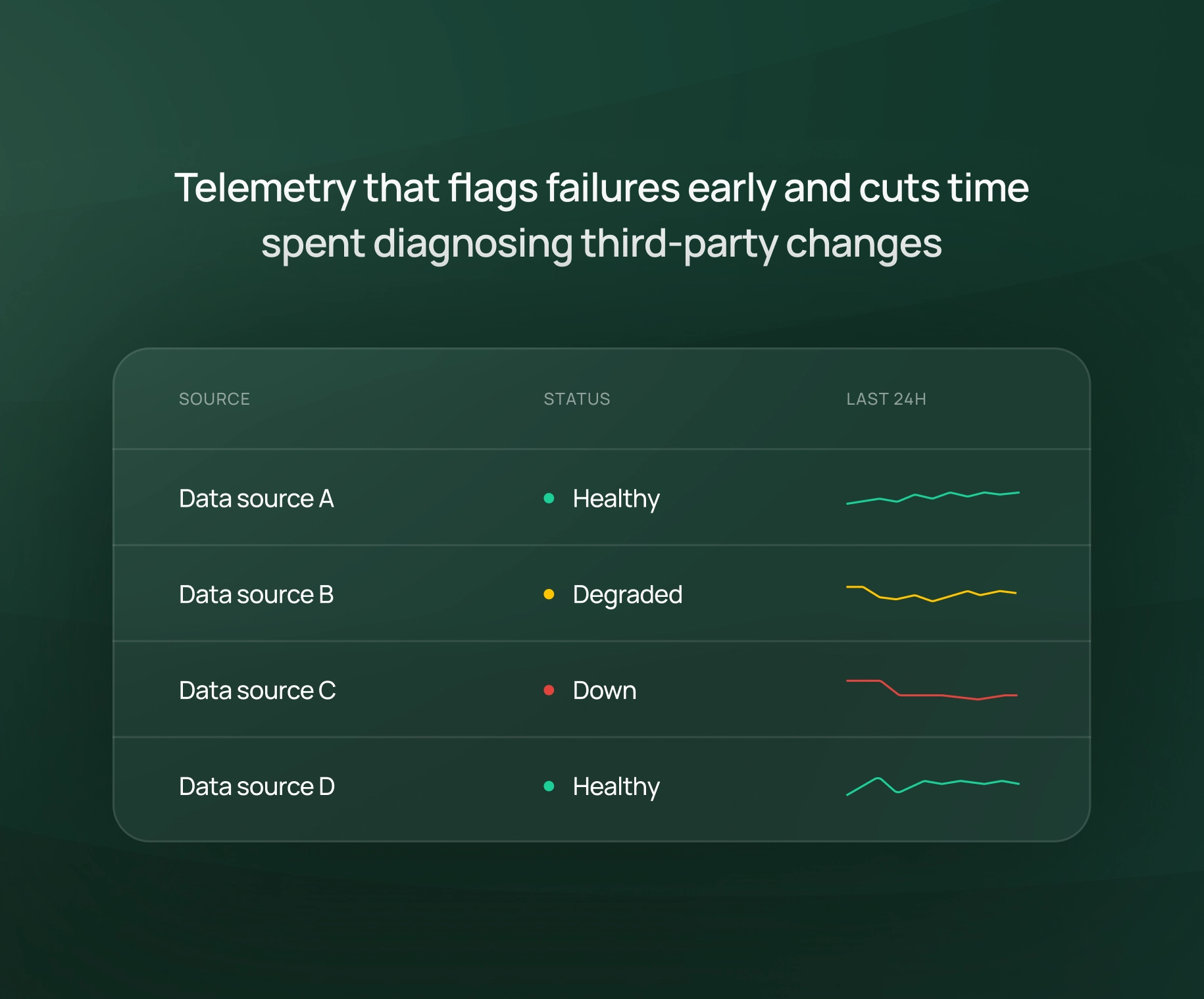
To get there, the team expanded the supported “data source” catalog to roughly 100 integrations, so a wider range of verification checks can be run from the same system. Each integration sits behind a consistent interface, which means partner teams can add a new source without having to learn the quirks of every underlying provider. The team also added monitoring to detect and debug changes in external services faster — surfacing issues like an altered response format or an outage early, instead of leaving them to be discovered downstream.


Scope of Work
Expansion of the platform along three lines: broader verification coverage across many sources, support for message-based protocols (WebSockets) in addition to standard web traffic, and a more adoptable SDK that partners can embed under their own branding. It also introduced stronger operational visibility to see what’s working, what broke, and where to focus fixes.
Data-source expansion at scale
Grow support to ~100 sources, validate each integration, and handle edge cases where request patterns required manual investigation.
WebSocket proof support
Add support for proofs where the key signal arrives as WebSocket messages rather than classic request/response traffic, which required a different capture and verification approach.
Android capture hardening
Add an additional capture layer on Android for sources that didn’t work reliably with default WebView behavior or raised security concerns in embedded flows.
SDK productization and white-label readiness
Evolve the SDK into a partner-friendly offering across iOS, Android, and React Native so external teams can integrate faster without rebuilding proof logic.
Data-source monitoring and alerting
Introduce telemetry and logs to track data-source health, highlight failures early, and reduce time spent diagnosing issues after a third-party service changes.
New proof categories, including attachments
Extend proof flows to cover verification scenarios like uploaded assets (e.g., validating that a video campaign was published as claimed).
Solution
The team integrated a much larger set of sources and built a repeatable approach for defining what should be captured and how it should be verified — even when the same proof category behaves differently across providers. vouch shifted from “make it work once” to “make it work across many real services.”
Currently, vouch reliably supports verification across three different verticals: Non-Doc KYC & KYB, candidate authenticity, and social & audience verification using an automated privacy-first approach without document uploads.

Team composition
This stage combined mobile delivery with backend ownership of the proof engine and source logic, with fast validation cycles as new integrations came online.
Mobile Engineers
QA


.png)

%201.png)
