Can sign-language interpretation be delivered offline on museum tablets using Flutter + Bubble?

We partnered with a local museum and the Katarynka Foundation — which professionally adapts content for socially excluded audiences — to build an inclusive digital guide for deaf visitors. From zero to a working POC in three weeks.
Heart
2023
Cultural institutions are expected — legally and ethically — to be accessible to everyone. In practice, deaf visitors routinely get a lesser experience: a "sensory gap" between what an exhibit offers and what they can actually take in.
An offline-first, tablet-based museum guide that delivers educational videos with subtitles and signed interpretation. Designed with accessibility specialists from day one and shipped as a working MVP in three weeks.
The problem space
Access to information is a basic right, and cultural institutions are some of its most important custodians. Yet the people who most need adaptation are often the ones an exhibit serves worst. For deaf visitors, audio guides, narrated films, and spoken tours are simply unavailable — and captioning alone doesn't match the comprehension a native sign-language speaker gets from signed content.
people worldwide live with disabling hearing loss today (WHO)
projected by 2050 — over 8% of the global population (WHO)
of surveyed North American science museums report 75%+ of exhibits accessible to deaf visitors — the majority fall short
Researchers describe the shortfall as a "sensory gap" between cultural content and the visitors meant to receive it (Perspectives in Human-Media Interaction, 2022). Hearing loss compounds into economic and social exclusion when institutions don't adapt. The open question for an R&D sprint: could a credible, deployable guide be built fast and cheaply enough that a single museum — not just a national institution with a large budget — could actually run it?
Technology choices
What we evaluated, what we chose, and why. The constraint that shaped every decision: a working MVP in 3 weeks.
Cross-platform SDK covering Android tablets and iPads from one codebase. We needed precise control over a custom video player (subtitle toggle, audio muted by default, distraction-free UI), and Flutter's rendering engine gave us that control while still letting us build a polished interface quickly.
No-code admin panel for user management, magic-link generation, video categories, and video/caption upload. It met the three-week constraint with zero backend engineering, and — critically — left museum staff with a tool they could operate themselves.
A credible cross-platform alternative, but Flutter's rendering control offered a better path to the tablet-optimized custom video player UX we wanted.
Would have added 4+ weeks. Bubble covered every admin need at the POC stage. Flagged as the necessary replacement once the product scales beyond a single institution (see Results).
The POC in action
The working thing — oriented around capabilities, not a scope-of-work list.
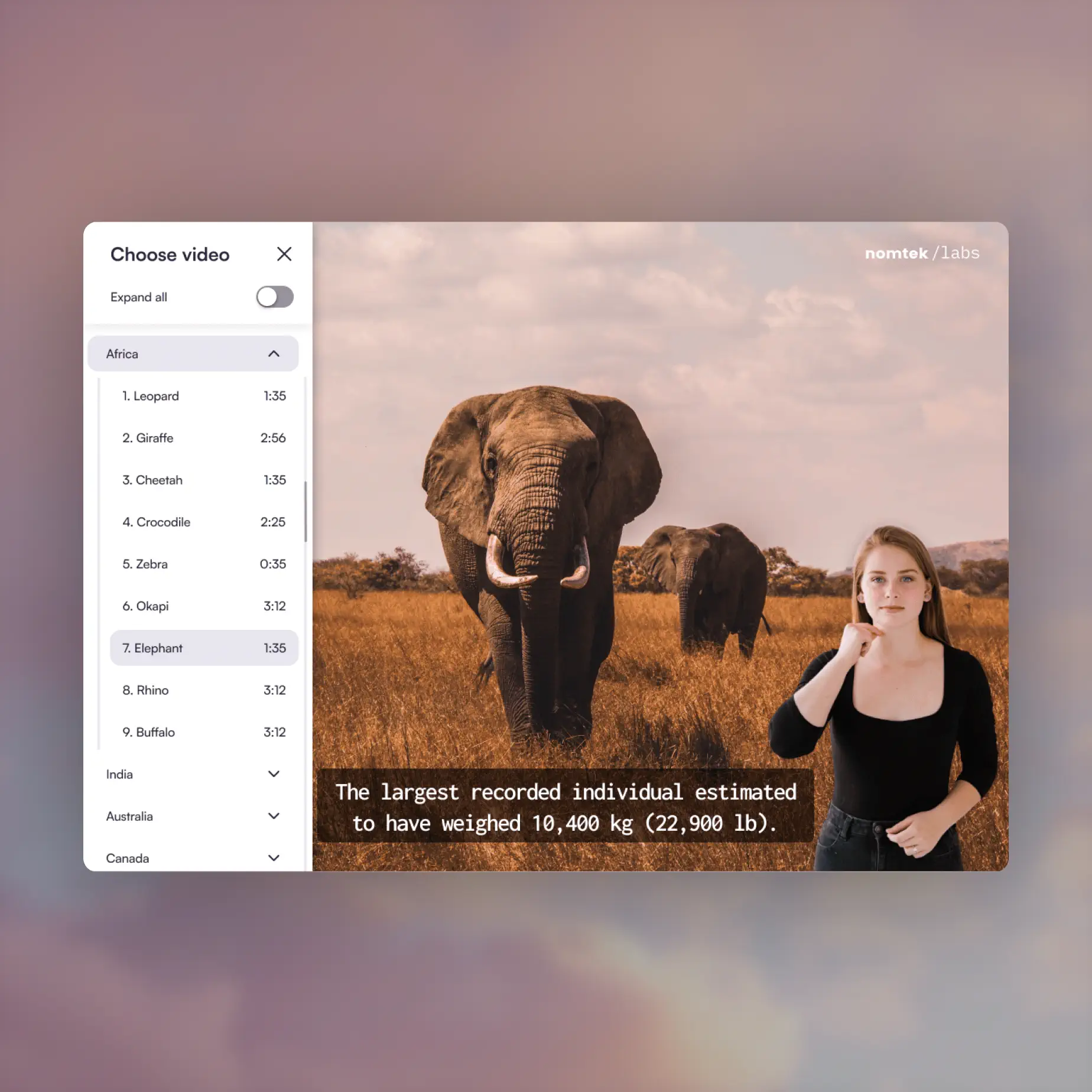
Many museums have limited or no internet, including spaces underground or in older buildings. Videos are downloaded once during initial configuration, then play with no connection required — so the guide never stalls mid-exhibit.
Built specifically for this use case. Audio tracks are muted by default; the interface is stripped to only what matters, with a clean subtitle on/off toggle. The guide assists the exhibit rather than competing with it.
A no-code Bubble.io panel lets museum staff add users, generate magic links, create video categories, and upload videos and captions — no developer involvement after setup.
Results & takeaways
The R&D equivalent of an impact section. For a POC, honest feasibility findings build more credibility than a polished success story.
A single cross-platform codebase delivered a polished, distraction-free player on both Android tablets and iPads within the sprint.
Museum staff can manage videos, captions, categories, and access independently — no engineering involvement after initial setup.
Multi-museum rollout with role-based access control, larger media libraries, and content governance pushes past what the no-code layer supports.
The same offline, captioned-and-signed delivery fits well beyond museums: hospitals and clinics presenting patient information to deaf patients, public transport and transit hubs, government service centres, and classrooms — anywhere a regulated institution is obliged to serve deaf audiences. An avatar-based signing pipeline would remove the manual video-recording bottleneck and make rollout across many such institutions economical.
