Can a FigJam whiteboard become a spatial, hand-tracked workspace that distributed teams share in real time?
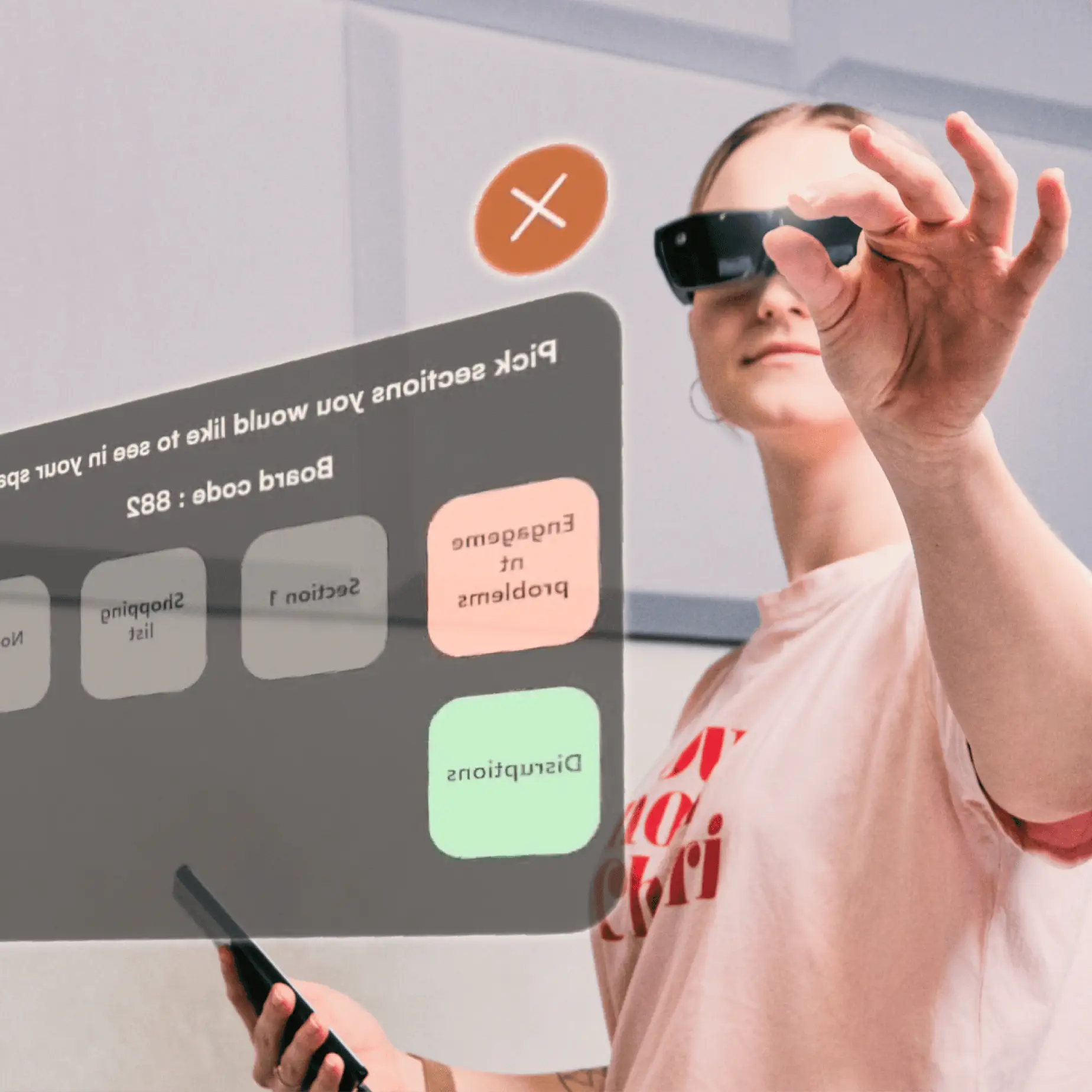


In collaboration with Qualcomm, we built StickiesXR on Snapdragon Spaces — an XR prototype that lifts FigJam's flat sticky-note board into the room around you. Walk up to your notes, move them with your hands, and watch everything sync back to FigJam in real time.
StickiesXR
2023
We wanted to know whether emerging XR hardware could bring back the spatial, physical feel of brainstorming without losing the digital workflow teams already rely on.
An XR whiteboarding app on Qualcomm Snapdragon Spaces. Users place and arrange virtual sticky notes anchored to their real environment, manipulate them with hand gestures, and collaborate in a shared space that syncs to a FigJam workspace in real time.
The problem space
Whiteboarding is the most spatial form of teamwork there is — people stand, point, cluster notes, and read the room. When teams went remote, that ritual collapsed into a flat canvas on a laptop. The open R&D question: had XR hardware and tracking matured enough to make spatial collaboration feel natural, while still plugging into the 2D tools (FigJam/Figma) teams won't abandon?
controllers needed — notes are manipulated by hand gesture alone
XR headsets supported (Lenovo ThinkReality A3, Meta Quest Pro)
sticky notes sync straight to a shared FigJam workspace
Note: this is an exploratory XR prototype, so external problem-space stats are thinner than a market-driven product. Flagged figures above are optional — confirm before publishing or drop the band and keep the prose.
Technology choices
What we evaluated, what we chose, and why.
The core enabler. Its hand-tracking let us manipulate notes with natural gestures, and Local Anchors let the board realistically co-exist with the physical room. Building on Snapdragon Spaces also opened cross-device support rather than locking us to one headset.
Rather than inventing a new canvas, we synced to FigJam so the XR session feeds the tool teams already use. Notes created in XR upload to the FigJam workspace live — the bridge between spatial brainstorming and existing 2D workflows.
Consistent with our other Snapdragon Spaces / XR work.
Rejected. Tying the build to a single vendor's SDK would have killed portability; Snapdragon Spaces gave us a cross-device path.
Rejected as off-thesis. Another flat canvas would have ignored the entire reason for the experiment — testing whether *spatial* collaboration adds value.
The POC in action
The working thing — capabilities, not a scope list.
Virtual notes are anchored to your physical space. You move around them as you would a real wall of stickies — clustering, grouping, reading the layout spatially.
Snapdragon Spaces hand tracking lets you grab, move, edit, add, and delete notes with natural gestures — no controllers required.
Notes synchronise live to a shared FigJam workspace, so XR participants and teammates on a laptop stay on the same board.
Local Anchors keep the board stable and believably fixed in the room across the session.
Results & takeaways
Honest feasibility findings for an XR exploration.
Gesture-based grab/move/edit was viable and intuitive enough to brainstorm with, not just demo.
Teams don't have to abandon their tool to gain a spatial layer — the value is additive, which lowers the adoption barrier dramatically.
The experience ran on a small set of headsets (ThinkReality A3, Quest Pro). Until XR hardware is widespread in the enterprise, this is a forward-looking capability rather than an everyday tool.
Beyond distributed product and design teams, the natural verticals are architecture, engineering and construction (collaborative model and site-plan reviews), industrial and product design, and training and education — fields where people already think in space. As mixed-reality headsets proliferate there, the same FigJam-synced thesis gains real reach. (StickiesXR was an AWE Auggie Awards "Best Snapdragon Spaces App" entry.)
