Can ultra-wideband turn an ordinary smartphone into a centimeter-accurate museum guide?


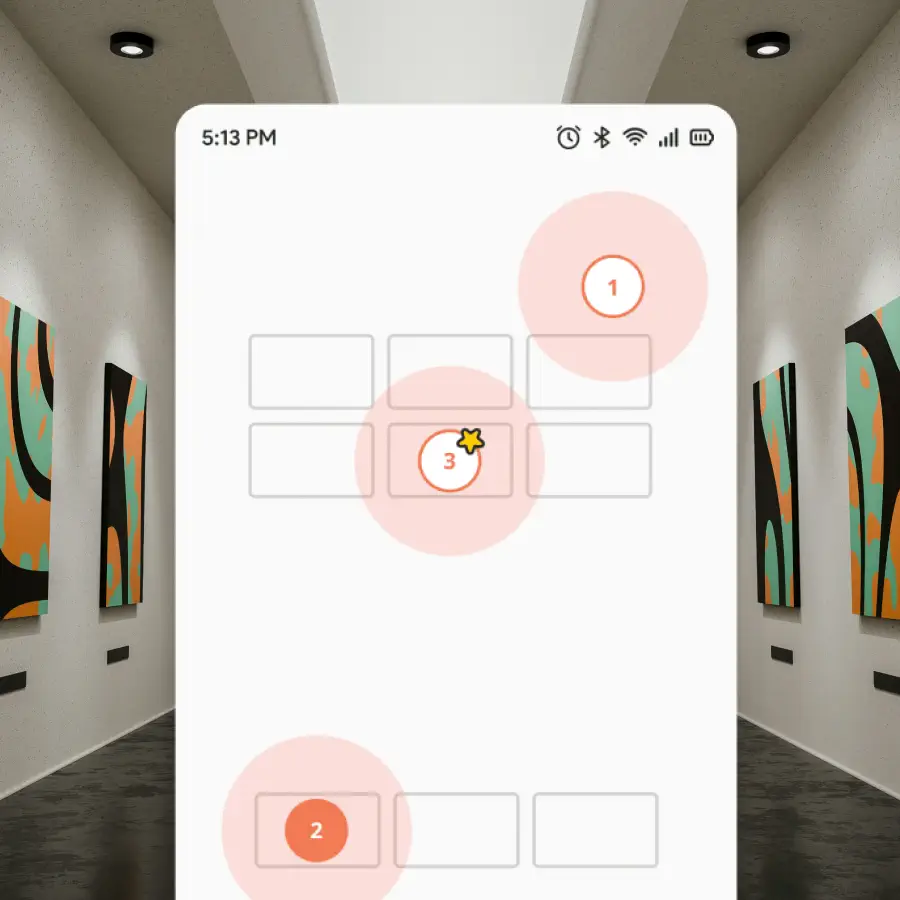
As museums worked to rebuild attendance, we asked whether ultra-wideband — the centimeter-precise radio tech newly arriving in smartphones — could power a better indoor guide. We built an Android prototype that detects UWB anchors and delivers contextual exhibit content the moment a visitor steps into range.
UWB Art Guide
2022
UWB chips shipping in smartphones, promise centimeter-level positioning. We wanted to test, with healthy skepticism, whether that new capability was ready to carry a real indoor-navigation product.
An Android (Kotlin) prototype that locates UWB anchors in real time and notifies the visitor when they enter an exhibit's range, surfacing a description, images, and optional audio.
The problem space
Indoor positioning is the gap GPS never closed — it doesn't work well inside buildings. BLE/Bluetooth beacons partly filled it but with coarse accuracy. UWB changes the ceiling: operating in the 3.1–10.6 GHz band, away from the crowded 2.4 GHz spectrum, it locates devices to within centimeters. The open question for 2022: now that UWB chips were appearing in phones but official SDKs were brand new, was the technology mature enough to build a real consumer experience on — or still a lab curiosity?
UWB positioning precision — vs. metre-level for BLE
first UWB chips ship in smartphones (Apple leads; others follow ~a year later)
UWB radio band, clear of the crowded 2.4 GHz spectrum
Technology choices
What we evaluated, what we chose, and why. The honest framing: this was a feasibility probe, not a product bet.
The whole point of the experiment. Centimeter precision and resilience to interference promised exhibit-level location triggering that BLE couldn't match — if the phone-side implementation held up.
At the time, UWB developer access was more open on Android than iOS, so we built Android-first to actually exercise the radio.
Exhibit content (descriptions, images, audio, trigger ranges) is managed in Airtable — fast to stand up and editable by non-developers, right-sized for a prototype.
The mature, conventional approach. Rejected for this experiment because metre-level accuracy wouldn't demonstrate UWB's distinctive value — though it remains the pragmatic choice where centimeter precision isn't required.
Deferred. UWB API access was more restricted on iOS in 2022; Android gave us a faster path to a working ranging prototype.
The POC in action
The working thing — capabilities, not a scope list.
When a visitor enters an exhibit's range, the app fires a notification and surfaces a description, image, and — where available — an interactive audio player.
A fully touch-enabled plan with exhibit pins, visible trigger ranges, favorites, and a scrollable exhibit list, plus a guided UWB connection flow.
Once connected, the app shows the visitor's position and the distance to each exhibit.
Museum staff manage all exhibit data through an Airtable admin panel that feeds the app.
Results & takeaways
The honest findings are the point of this one — limitations build more credibility than a polished win.
Anchors, proximity triggers, the floor plan, and content delivery all came together into a coherent, usable guide.
It's technically viable but drains the battery fast, shows stability issues, and works best for a single static measurement rather than continuous ranging. In crowds, the signal passing through people degrades distance accuracy.
Few Android phones shipped UWB chips, and commercial beacons were early-stage (e.g., Estimote had no Android SDK at the time) — limiting any real-world rollout.
Strong potential as the hardware matures. The honest evaluation: UWB's centimeter precision is real but still power-hungry and thin on supported devices, so the clearest near-term industries are access control and security, logistics and warehousing (asset tracking), and retail payments — with indoor guides following as phones and beacons catch up. Where precision matters less, the same UX can ship today on BLE.
